

Hello, and welcome to my Substack. Remember if you want to support my writing, you can do so by becoming a paid subscriber, buying me a one-off Ko-fi or buying one of my books. Or all of my books.
Review - Homelessness in Performance, Art and Society: Becoming Visible
I was grateful to be given a review copy of Nadine Holdsworth’s book on homelessness and performance, tackling as it does the intersection of a number of subjects that appeal to me: homelessness, working class (or dispossessed class) art, and how organisations can engage with creatives who come from less privileged demographics.
The first thing to say about Holdsworth’s book is it is an academic text, written by and (presumably) for academics, and published by an academic publisher - Routledge isn’t putting out your mass market paperbacks. So while I think it has a lot to offer creative practitioners interested in this area, it’s not a fast or easy read and you have to go in expecting the kind of language and framing academics use. But it definitely has a lot to offer beyond the narrow fields of academia.
The book focuses on several key strands. It opens with the work of individual artists (including North East based artist gobscure, whose artwork adorns the cover, and who has performed at a number of North East venues, including Live and Alphabetti, and who also has a Substack - see below). Analysing how these artists’ work is grounded by and often stems from their lived experience of homelessness (often intersecting with other experiences, including disability and mental health issues), it then moves onto looking at creative organisations that focus on work with and performances by individuals or communities who have experienced homelessness.

Holdsworth also examines the tensions between the goals and impact of organisations which take a more ‘capitalist’ approach to their work with homeless individuals, who emphasise stories of creativity, triumph and personal redemption, thereby minimising or even ignoring structural and systemic issues, despite the practical good they might be doing.
The book concludes with a deeply moving section on projects that memorialise deaths among those who experienced homelessness, and how a deliberately performative element to these projects can increase their effectiveness, drawing on parallels with other memorialising projects such as the deeply memorable ‘AIDs quilt’.
Holdsworth doesn’t seek to offer simple solutions, but the book gives us lots to think about when it comes to artists affected by homelessness, how organisations can thoughtfully engage with and support those experiencing homelessness (including tapping into the creativity of those who would normally not consider themselves ‘artists’), as well as looking at how art and performance can be acts of solidarity and (hopefully) catalysts for change.
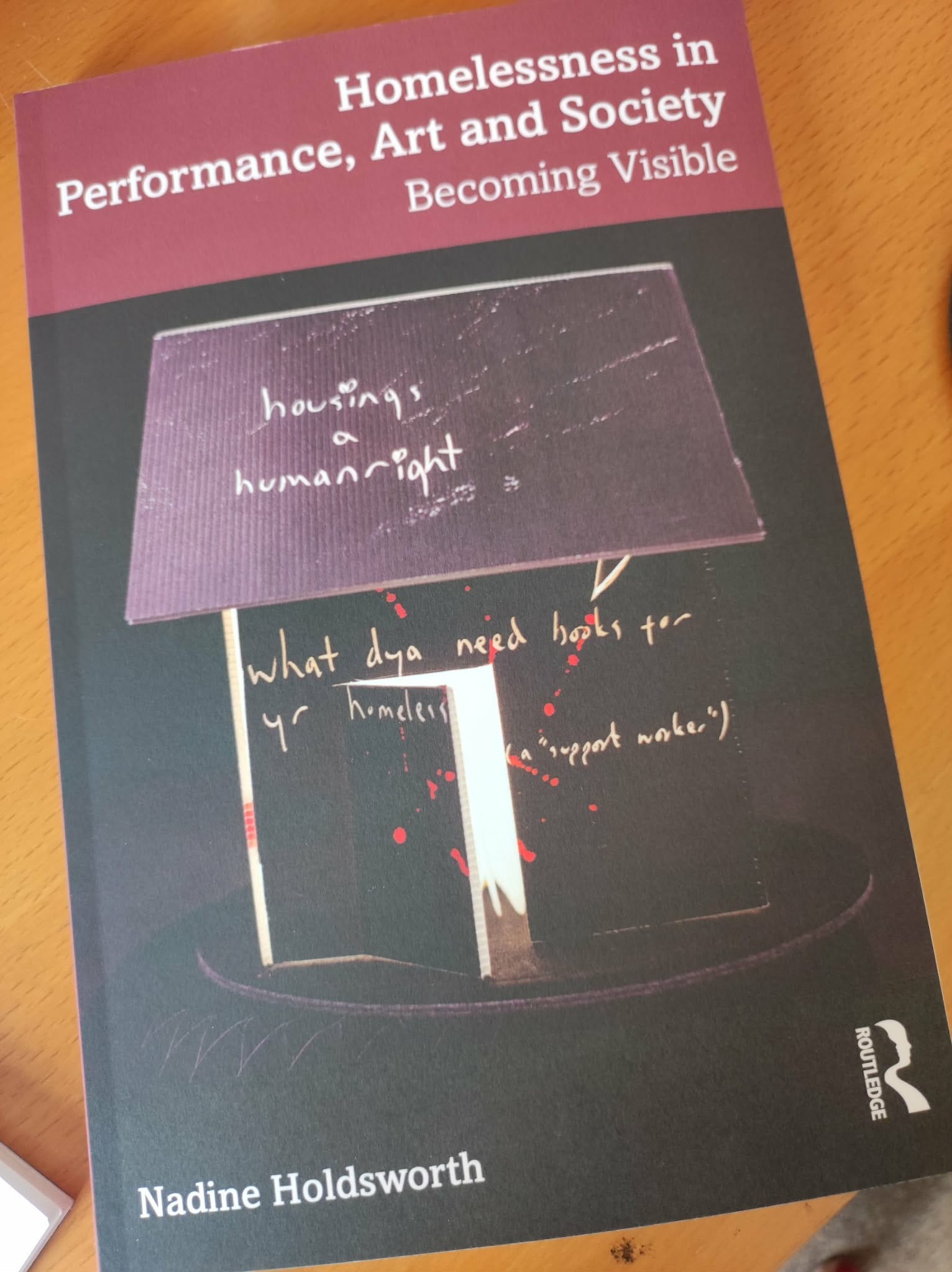
[Image description: Homelessness in Performance, Art and Society by Nadine Holdsworth]
And in honour of this book - and in part to explain my personal interest in it - I thought I would reshare this earlier piece on my own (obviously limited) experience of homelessness, which I would offer as evidence that ‘homelessness’ isn’t some vague thing that happens to Those People (who probably deserve it, right?) but something many of us are one lost job or bad landlord or relationship breakup away from.
(Originally published in around 2018, I think).
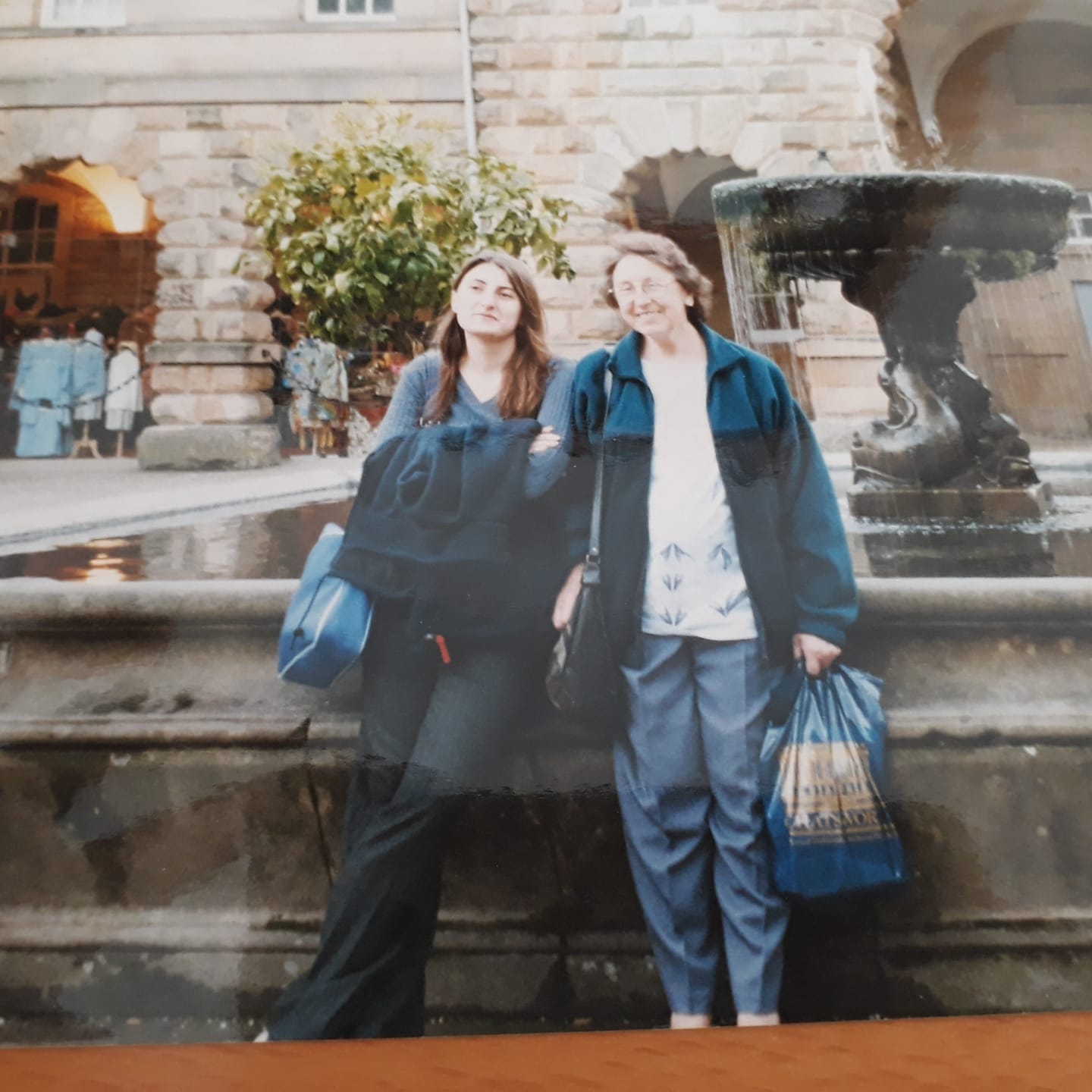
[Image description: Tracey with Mam, standing in the grounds of some fancy place, in front of a fountain]
The Summer I was Homeless
Some words have such a weight you can’t carry them. They are so freighted with import, with the expectations of others or the ages, you shy away from applying them to yourself because you simply can’t live up to them. So, five years ago, when I became, in fairly rapid succession, both homeless and an orphan, I found myself in the curious position that the words that most literally described my situation didn’t accurately describe it at all.
After all, I was a woman in her 40s, not some Dickensian waif left to fend for herself in childhood. I was hardly unique in having lost both parents at that age (I presumed, at least – if you’re out there, hi Dad! Fuck you!). Unusual, perhaps, in the extent of my aloneness – only child of a single mother, without siblings or a partner or children – but certainly not worthy of any special pity.
Then there was the homelessness. I wasn’t homeless, surely. That was ridiculous. I had a job (OK, I was freelancing, but I had a regular income from my nascent business). I had savings (OK, not much, and even less when I took the costs of my mother’s funeral out of them). I wasn’t on the streets, or in a hostel. I wasn’t homeless homeless. I just… didn’t have anywhere to live.
And then I still didn’t have anywhere to live.
At first, it seemed a temporary inconvenience. The flat I had spent a decade in – at first shared with others, latterly alone – abruptly became unavailable, as the friend from whom I rented it at ‘mate’s rates’ broke up with his partner, and needed to move back in. So, without a contract, I had to leave, and I was suddenly faced with a rental landscape that had dramatically changed in my absence, and which I was now brutally priced out of.
I wanted to stay in my neighbourhood – an up and coming but not particularly salubrious part of South London – but even a cursory scan of the local estate agents made it evident that my freelancer’s income would barely afford me a partially furnished cupboard. Having had my share of creeps and crazies, I had hoped I was done with flat-sharing, but partnerless and without access to the parental purse (my mum was a pensioner, on benefits and in social housing), living alone seemed beyond me. I had to face the depressing possibility of sharing with someone a decade or two younger, trapped in some extended kidulthood by my lack of finances. But still, I decided to give it a go, even though the first flatshare I investigated turned out to be a dodgy sublet with a landlord who insisted there be no paperwork and that he be free to let himself in without notice, ‘day or night’ to collect the rent – in cash. Clearly, this wasn’t going to be easy.
Then my mum died, and I had a whole other set of problems.

[Image description: slightly blurry photo of me and my mum]
Well-meaning middle class friends, while sympathetic to my loss, assured me this would at least solve my immediate housing crisis: I could move into my mum’s flat in Newcastle while I sorted out her things. But they were oblivious to the reality of social housing, which has no space for grief. I had to strip away two and a half decades of my mum’s life in mere days* to make way for the next tenant. And, because her benefits were cancelled on the day of her death but her bills were not, the fact that she died at the start of the month meant I was also charged rent to do so.
‘You’ll regret not taking something to remember her by’, people told me, as if the most complicated relationship of my life could be encapsulated in a souvenir. But more than that, the practicalities of possessions were beyond me. I was living out of a suitcase, the meagre belongings I had were in storage (not much, since I had always lived in furnished flats). The logistics – and cost – of putting my mum’s things into storage in Newcastle, then transporting them to some as-yet-undecided destination, seemed overwhelming to me.
My business – and therefore my income – was suffering. On top of the fallout of grief, there was the enormous amount of paperwork death generates, the red tape and official incompetence I had to manoeuvre to detach my mother from the world, from sending out death certificates to everyone from the TV licence people to the insurance company (and then, doing so again, because the latter lost the first one), to endless form filling and phone calls, the wearying litany of constantly having to reiterate your loss for an uninterested audience.
Then there were the practicalities of trying to do any of my own work in a flat that was being dismantled around me, no longer had a landline, and had neither wifi nor a decent mobile signal, meaning the only way I could get online was to walk 10 minutes to the café down the road: a partial, but not always practical, solution to the demands of a business I was attempting to grow.
With time, I might have managed to sell her things, dispose of them thoughtfully and maybe even to my profit, but with the clock ticking on eviction, clearing the decks was a priority, so I ended up frantically trying to give away a house full of furniture I desperately needed.
And still I had nowhere to live.
Favours were called in, Facebook posts put out. And people were lovely beyond my expectations. Over the next few months, I was, time and again, stunned by the generosity of the friends who opened their homes to me. Friends invited me to housesit or pet-sit when they went on holiday, thus clothing their kindness in the pretence I was doing them a favour. People I worked with years ago got in touch to offer their spare room for a week. Acquaintances messaged me to say their parents had a holiday home I could rent out for a month; a woman I met once on a hen night a decade earlier offered me her flat for a week while she was away.
There were some cutting absences, true. Grief frightens some people, and they have to steer clear, and by now I was doubly grieving, since in the midst of this chaos I was rocked by the unexpected death of an old friend, far too young, reinforcing my impression of a world gone off its hinges. I was tired and weepy all of the time (the one thing that nobody tells you about grief: it’s utterly, bloody exhausting), so not exactly the cheeriest of friends. I get it, I do: other people’s crises wear thin after a time, and everyone has their own drama and daily life to deal with. But still, I was hurt by the disappearance of some people – some of whom emerged, later, with talk of having wanted to give me space (when space was the last thing I needed), others leaving cracks in our friendship that would prove impossible to heal over.
But, in the main, kindness followed kindness followed kindness. It wasn’t an ideal life, by any means, but I kept reminding myself I was lucky. I was spending a fortune on train tickets as I travelled from one city to another, lured by the offer of a spare room or a holiday flat-sit, but hey, at least I was getting to travel. (My stays in London were limited by the fact that, no matter how generous my friends were, most were as constrained by economics as I was: spare rooms were in short supply, and there’s only so long you can kip on someone’s couch without seriously straining a relationship).
My job – while suffering from the instability and the time I spent looking for somewhere to live and/ or arranging and travelling to somewhere to stay – was at least flexible enough that I could do it from anywhere. And while my savings were rapidly diminishing, I had credit cards: if things got too desperate, I could stay in a hotel, and worry about paying it back later. I was painfully aware that I was better off than many, and terrified that if I complained about – or even identified as – homeless, I was belittling the genuine strife of the ‘real’ homeless people.
So, I soldiered on in a swirl of grief and fear, made worse by refusing myself the freedom to articulate – or even admit to myself – how scared and alone I felt. Because I was scared, and I felt alone. Friends reassured me, ‘you’ll always have somewhere to stay’, but how to explain the shame and the terror of starting the week not knowing where you will be sleeping at the end of it? How could I be confident with my clients, when I was constantly anxious that they would find out my situation and decide I was clearly too feckless to be trusted with their work?
My situation not only triggered a sense of shame at how I had allowed myself to fall into this state of affairs, but it threw all my other failings into sharp relief. If I was more skilled at my job, a more talented writer, a more organised or successful person, I would own my own place by now. If I wasn’t such an unlovable, unfuckable car crash of a woman, I would have a husband, a boyfriend, a partner to share the burden. In short, if I were just better, I wouldn’t be carting my life in a suitcase from one sofa to another.
I was grieving not just my mother, and my friend, but my life. And my grief felt toxic and infectious. I curtailed visits with friends, desperate not to outstay my welcome, keen to maintain the pretence I was a fun guest, not a charity case (not sure how much fun I actually was, mind, since after the third glass of wine I had a tendency to cry). But I also felt like if I hung around with anyone too long I would somehow taint them, and our friendship would never recover.
(My one, spectacular breakdown came in private: or, at least, the strange privacy of the public meltdown. Back from my friend’s funeral, trekking to a flat I had never seen that had been kindly proffered for a week by someone I barely knew, the wheel of my suitcase broke halfway up Herne Hill. And I sat down in the street and bawled my eyes out, utterly convinced that, even if someone had run up and pointed a gun at me, I would have been unable to physically move another step. I have no idea how long I sat there, cradling my laptop bag, sitting on my suitcase, oblivious to the concerned stares and curious mutterings of passers by, until I managed to drag myself up the road to once again go sleep in a bed that wasn’t mine, but it was probably longer than I have allowed myself to remember. ‘By Herne Hill Station I Sat Down and Wept’ doesn’t have quite the same ring to it as Grand Central, but it might well be a chapter title in my autobiography.)
I had set my sights to Brighton, drawn by the idea of the sea and the fact that I had friends there. I foolishly believed it would be simple, not taking into account a fiercely competitive rental market where a flat was often let before I turned up to view it or, on one occasion, while I was still being shown around. I wasn’t in Brighton all the time, not wanting to wear out my friends’ welcome before I even moved into their neighbourhood, so the time I could spend flat-hunting was limited. My freelance status was a hurdle I hadn’t anticipated; agents required a guarantor, which I didn’t have. (‘Can’t you ask your parents?’ one asked, cheerfully, and I had to flee before I cried). Or they wanted six months’ rent in advance, plus deposit, an amount that was impossible, especially as I had no deposit from my last place.
But finally, I got lucky. I found a flat that was just outside my budget but miraculously not rented the minute I looked at it, and affordable at a stretch, even if ‘at a stretch’ meant living on my credit card for a while. By then, not paying London-level rent for five months had allowed me to put aside a deposit, and a small insurance pay out meant I had recouped at least some, if not all, of my mother’s funeral expenses.
It wasn’t a smooth transition, and it brought with it another reminder of my shortcomings. I was 43 years old and had never owned furniture; I had no idea how to buy it, or how long things took to order, so I slept on the living room floor for two weeks, until the sofa bed arrived (the bed took six – six weeks! Who can wait six weeks for a bed?) My house ended up furnished mostly by friends who, serendipitously, were having a remodel of their own place, and generously gifted me their old things. Even now visitors marvel at the fact I have a dining room table, their confusion only clearing when I tell them I got it for free.
The aftermath
Reframed by hindsight, I can see the positive side of the experience. It kicked me – with more force than I would have liked, admittedly – out of the London bubble I had been in and reminded me there are a whole load of ways of living that are Not London, and yet still worthwhile (a lesson it is shamefully easy to forget). It showed me, time and again, the hearts of friends and strangers, while also providing a tough lesson in just who my friends were.
But it changed me in other, less positive ways. It made me more insecure. Despite growing up in a household with precarious finances, I always assumed I would have a roof over my head, and I am now grimly aware of how naive that was. My anxiety, certainly, has a new focus, when any lost contract or slip in perfectionism can trigger a spiral of ‘will I lose my clients, my business, my home?’ I know now it can happen, because it did.
It also put me in the disconcerting position of being a writer without the words to describe my own life. Even now I stumble over saying it, as if I am claiming too much (I wasn’t really homeless. I just didn’t have anywhere to live. For… um, several months.). I still feel a buzz of embarrassment that I somehow let myself go so off track. There’s probably some snobbery in there, too, if I dig deep enough: I am not like those homeless people.
Most of all, it made me angry. Angry that I could live in a city for a decade, working hard and doing, by most standards, quite well, and still couldn’t afford to rent there without reverting to the flatshares of my youth, while all around me I see shiny new buildings springing up with little purpose other than to stand empty and serve as some oligarch’s investment or money laundering scheme. It’s an anger that has only strengthened as I have seen Brighton neighbours forced out of homes they have lived in for years by landlords who want to double the rent or don’t want to fix the roof. When I saw my mum’s community dismantled, long-term residents displaced by the economic pressures of the Bedroom Tax. When I walk back from town and every shop doorway hosts a sleeping bag. Anger that I am living in a flat at the very top of my price range – and way, way out of the range of many – and still have to put duct tape on my windows to cover the holes in the frames that let the wind in.
And maybe the reason I am writing this, five years after the fact, is that I am realising the anger is more important than the shame. Because shame – shame that I failed at a system that was always stacked against me, that I never agreed or aspired to, and that, at its roots, will never value people like me – is debilitating and silencing. Anger is loudness and power. Anger spurs you to speak up: to recognise the struggles of others, the inherent unfairness of the system. Maybe I can’t change anything. But maybe by articulating my own experiences, I can validate the feelings and experiences of someone who can. Maybe that’s nothing. Or maybe it’s a start.
*I managed to extend this to just under a month, through various flimflam and because my mum died on a Bank Holiday (and I paid the rent for the full month), but the reality for many people in council or social housing is they have to clear out in a ridiculously short space of time after a death.
(This piece was first published in 2018 - and the housing situation has only got worse since then, so if you fancy sending some pennies in the way of Shelter or a similar charity, please do!)
Anyway, thanks again for reading – please do share with your friends! Every new subscriber really does give me a boost. And remember if you want to support my writing but a paid subscription isn’t for you (times are hard, I get it!), you can buy me a one-off Ko-fi or buy one of my books.
Remember: everything included is my personal preference / opinion, and while I strive to be accurate, I always advising checking with the relevant venue.